

Why Most Flight Delays Don’t Start in the Air
The global aviation system is operating under sustained pressure. Demand continues to grow across regions, while infrastructure, staffing, and fleet availability struggle to keep pace. According to International Air Transport Association, airlines are navigating a structural imbalance between demand and operational capacity that is expected to persist for years.
In this environment, performance is no longer defined by ideal conditions. It is defined by how well operations manage delays. And a significant share of those delays originates on the ground.
Turnaround is where operational complexity concentrates
Turnaround is one of the few moments in aviation where multiple elements come together in real time. Aircraft, crew, passengers, equipment, and ground teams all converge within a narrow operational window. From an operational perspective, it is one of the most sensitive phases of the entire process.
Industry delay classifications and operational analyses show how many delay categories are linked to ground handling activities. These include:
loading and unloading
fueling
equipment availability
boarding and passenger flow
ramp congestion
In day-to-day operations, this is where delays often start. What makes turnaround critical is not just the number of tasks, but how tightly they depend on each other.
Small errors, real impact
Even a few minutes lost during turnaround is enough to affect departure slots and carry over to the next flights. In many high-density networks, average delays remain around 14-15 minutes per flight, with a large share linked to ground operations.
These delays often do not start as major disruptions. They start as small execution errors. Incorrect pushback positioning, delays in equipment handling, or procedural inconsistencies are enough to affect the turnaround.
The cost of ground operations is underestimated
Ground operations are often treated as a cost center, but their impact is significantly broader. According to International Air Transport Association, aircraft ground damage alone is projected to exceed $8 billion annually by 2030, highlighting how operational errors translate directly into financial impact.
More importantly, the cost of delay increases as disruption carries over through rotations, crews, and daily aircraft utilization. A few minutes lost during turnaround can extend far beyond a single flight.
In practice, this means that improving turnaround performance is less about isolated savings and more about keeping the operation stable throughout the day.
The training gap in ground handling
Despite the scale and impact of turnaround operations, training environments remain limited. Most ground handling training still focuses on procedures under stable conditions. However, real operations are defined by:
time pressure
incomplete information
shifting priorities
cross-team dependencies
Additionally, many of the most critical situations cannot be replicated in live environments due to safety and operational constraints. This creates a gap between training and real operations.
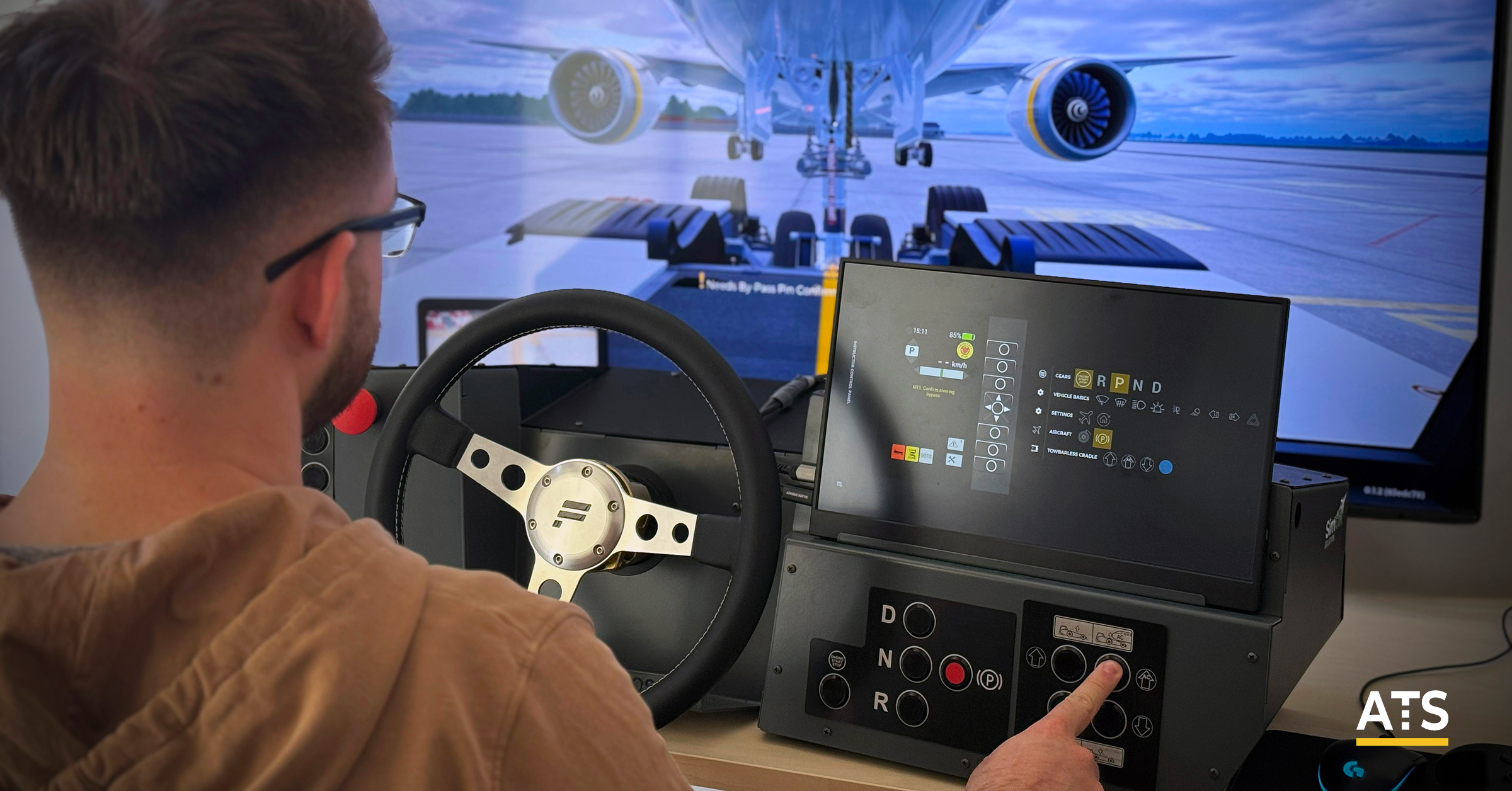
Small Errors Start Delays
Train Procedures Before They Reach the Apron
Airport Training Simulator as an operational environment
This is where an Airport Training Simulator (ATS) for ground handling becomes relevant. Not as a visualization tool, but as an environment where teams train real ground handling operations using the same procedures, equipment, and workflows as in live operations.
Instead of training isolated tasks, the simulator allows users to work through dedicated operational modules such as:
pushback (towbarless and conventional)
towing
de-icing
cargo operations
FOD procedures
airside driving
Each module reflects real vehicle behavior and procedures, focusing on execution, positioning, and coordination on the apron.
Many turnaround delays are not caused by major failures, but by small inconsistencies in execution. By improving how procedures are performed, the simulator reduces the number of errors that later turn into delays.
In practice, 10 days of simulator training can deliver a training effect comparable to around 20 days in live operations.
The value comes from repetition without operational constraints, exposure to real equipment behavior, and the ability to practice procedures multiple times without risk. This leads to more consistent execution and fewer operational errors on the apron.
From efficiency to resilience
The direction of the industry is clear. According to International Air Transport Association, ground operations are becoming more digital, more automated, and more tightly coordinated. At the same time, operations are becoming more sensitive to disruption as traffic increases and margins shrink.
Average delays are still around 14 to 15 minutes per flight in high-density environments, and a large part of that is driven by what happens during turnaround. Once a delay appears, it does not stay local. It carries over through rotations, crews, and aircraft for the rest of the day.
That is the real problem. Not single delays, but how easily they spread.
Improving both efficiency and resilience often starts at the execution level. Many delays originate from small inconsistencies in ground handling procedures, which can be addressed through better training and repetition.
By allowing teams to train real procedures repeatedly under controlled conditions, an Airport Training Simulator improves execution consistency and reduces the number of errors that lead to delays.
The goal is not to eliminate every delay, but to reduce how often they start and how far they spread.
Sources
https://www.assaia.com/turnaround-report-2025
https://www.iata.org/en/pressroom/2026-releases/2026-03-09-01/
https://www.iata.org/en/programs/ops-infra/ground-operations/ground-ops-of-the-future/
