

The Scenarios That Cause Ground Damage Are the Ones You Cannot Train on the Ramp
Every ground handling organization faces the same question at some point: how much training truly needs to happen on live equipment? In 2026, that question is no longer just pedagogical. It has become a financial and operational issue of the first order.
More than 29,000 aircraft ground damage events were reported globally in 2025. IATA's Director of Ground Operations, Monika Mejstrikova, put it plainly: "Unless we reduce the rate of these incidents, costs will multiply as the industry grows." IATA projects that without preventive action, the annual cost of ground damage could reach $10 billion by 2035, and estimates that smarter safety measures have the potential to reduce those costs by 42%.
Operator training is at the center of that reduction. But not all training is equally effective, and the industry's own audit data is starting to show where the gaps are.
What ISAGO Audits Are Telling Us
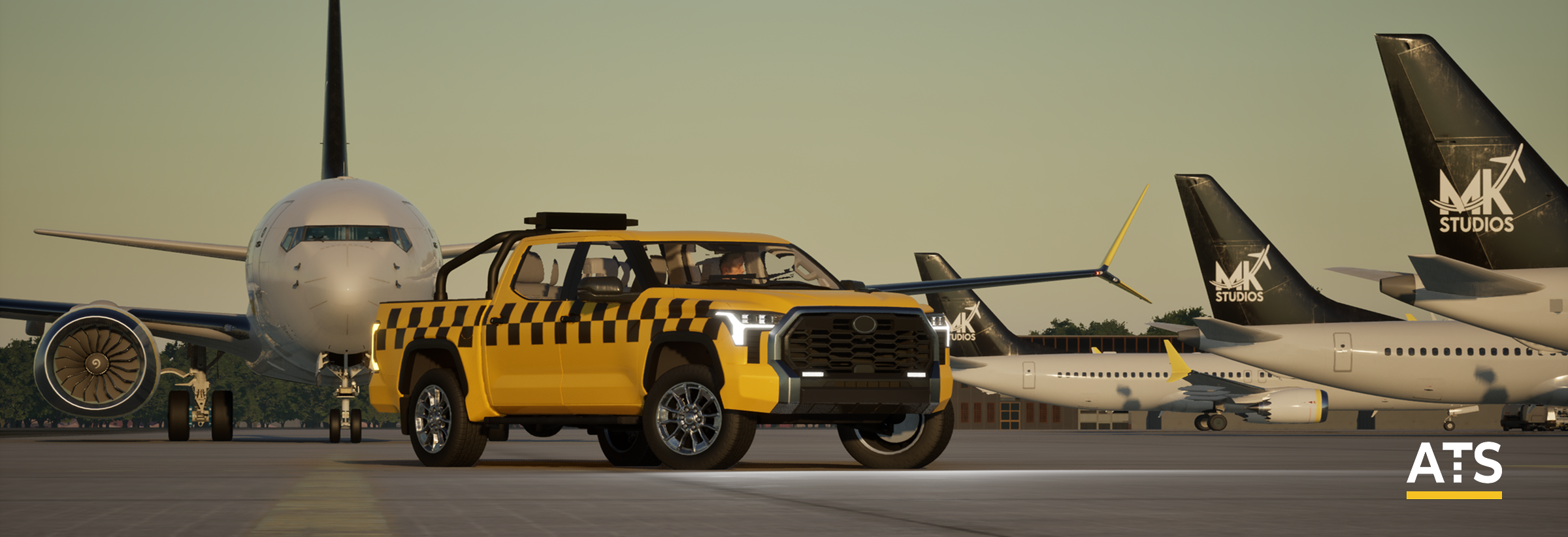
The IATA Safety Audit for Ground Operations provides the clearest industry-wide picture of where ground handling competency actually stands. In 2025, nearly 300 audits were conducted under the revamped ISAGO model, now supporting more than 230 ground handling service providers across 441 accredited stations at more than 250 airports, with more than 200 airlines relying on its audit reports.
Training consistently ranks among the top recurring findings across audit cycles. Inadequate operator competency, SOP non-compliance, and incorrect GSE operation appear not as isolated exceptions but as systemic patterns. Of the 582 organizations that shared their IGOM adoption data in 2025, fewer than 500 reported full alignment with AHM training requirements. A meaningful share of the global network is still operating with training gaps that IATA's own standards identify as safety risks.
These are not abstract compliance findings. Every training deficiency flagged in an ISAGO audit represents a real operator, working around real aircraft, with real financial consequences attached.
The Real Cost of Training on Live Equipment
Training on operational equipment has an obvious logic to it. Sooner or later every operator must work on the real vehicle, in the real environment, under genuine operational pressure. That part does not change.
What is often overlooked is what that training actually costs. A vehicle used for training is unavailable for operations. Fuel, power, tire wear, and maintenance costs continue regardless of whether the vehicle is generating value or developing a new operator. Experienced staff assigned to supervision are removed from productive duties for the duration.
Beyond resource costs, there is a deeper limitation. Training on live equipment is entirely dependent on conditions that no program manager can control. Traffic levels vary. Weather changes. Equipment availability fluctuates. Two operators completing the same training program may accumulate very different experiences as a result.
IATA's Ground Damage Report found that the majority of ground damage incidents occurring when an aircraft is stationary are caused by motorized GSE striking the fuselage, with belt loaders, cargo loaders, passenger stairs, and boarding bridges accounting for 40% of all incidents. These are precisely the vehicle types that new operators handle earliest. And the high-risk moments - the final approach to an aircraft door, the maneuver in a congested stand, the reaction to an unexpected obstacle - are exactly what live training cannot safely rehearse.
No responsible organization will recreate a near-miss with a parked widebody to test an operator's response. Yet those moments are where the 29,000 annual damage events are generated.
What Simulation Makes Possible
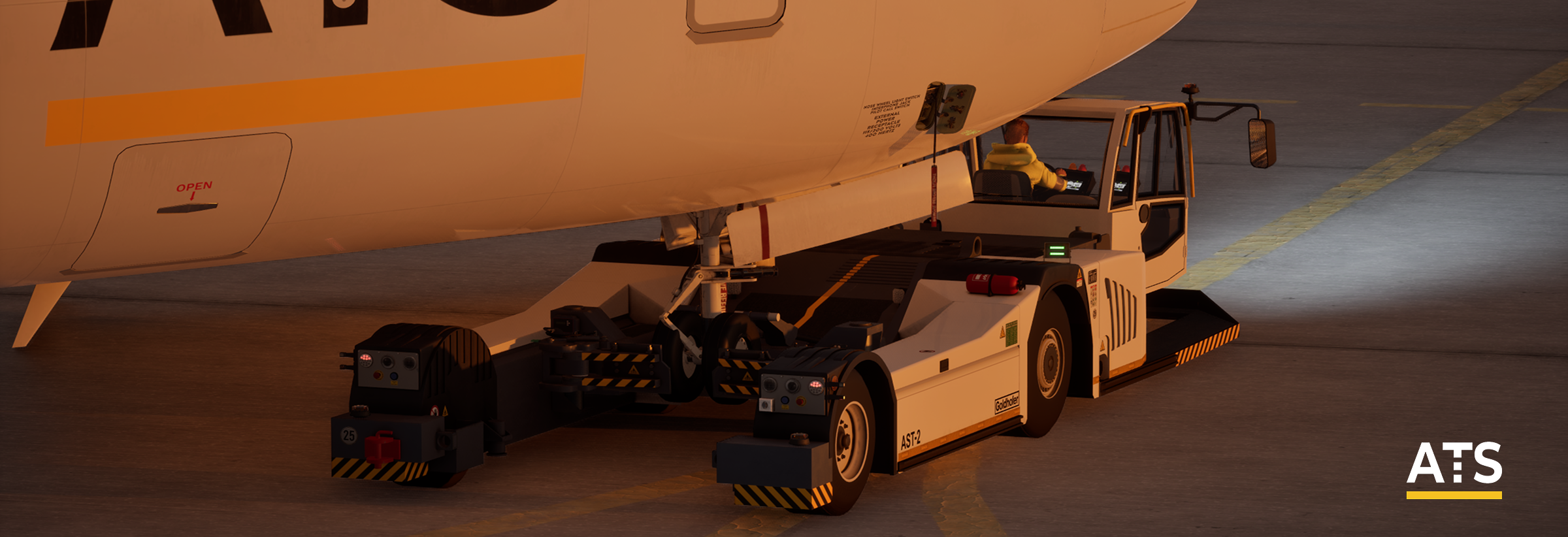
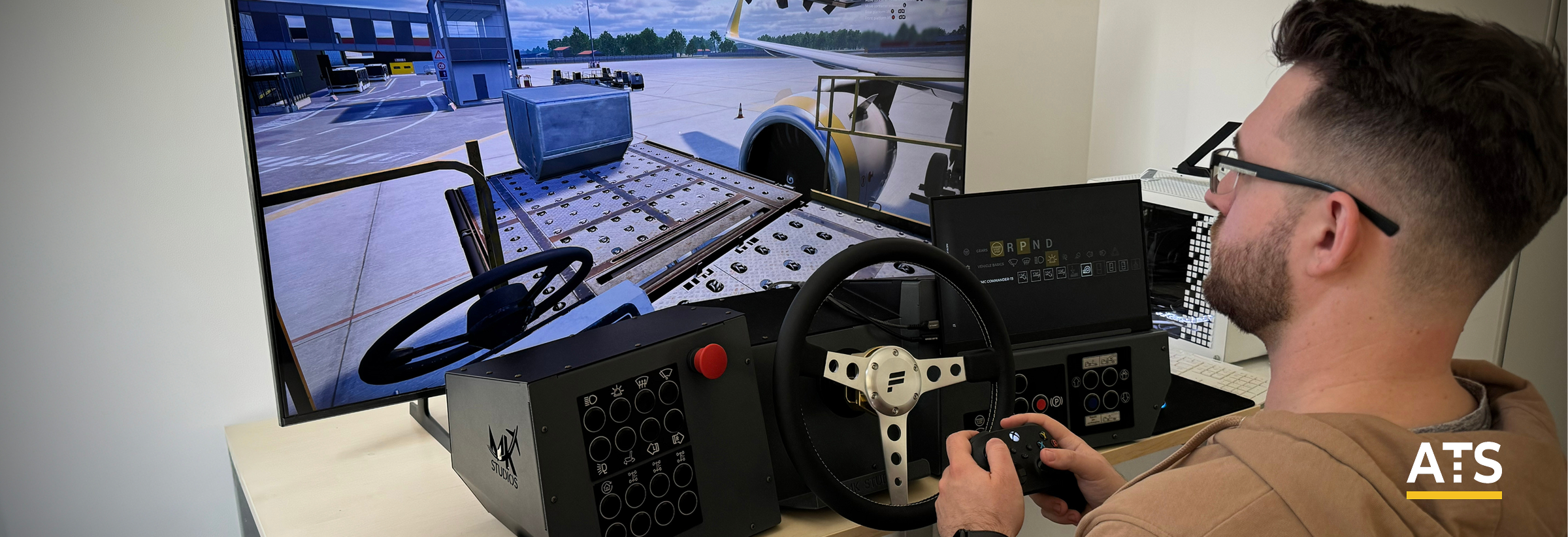
This is where simulation changes the equation. A simulator does not replace the ramp. It prepares operators for it.
In a controlled environment, trainees can develop vehicle familiarity, learn airport layouts, practise standard procedures, and - critically - experience the high-risk scenarios that live training cannot safely reproduce. Low visibility operations, congested stands, equipment malfunctions, communication failures, unexpected obstacles: these can all be introduced, repeated, and assessed without any operational risk.
When a trainee misjudges clearance or reacts incorrectly to a developing situation in a simulator, the scenario is reset and repeated. The lesson is learned. On the real ramp, the same mistake has a different outcome.
In 2025, nearly 38,000 aircraft loading errors were also reported globally. Many of these errors trace back to procedural gaps that form early in an operator's training. Simulation creates the environment to close those gaps before they reach the ramp.
The Case for a Blended Approach
The 38th IATA Ground Handling Conference in Cairo in May 2026 placed workforce transformation and training modernisation at the center of its agenda. The conference examined how human expertise, supported by AI and automation, can shape safer, more efficient, and more resilient ground operations. Structured pre-ramp training is one of the most direct expressions of that direction.
The most effective programs use both simulation and real equipment, in sequence. Simulation handles the early learning curve: procedures, vehicle controls, spatial awareness, and scenario-based decision-making. Practical training then focuses on what it does best - transferring established competency to the real vehicle and the real operational environment.
By the time trainees reach the equipment, they arrive better prepared. Instructors spend less time explaining basics and more time developing the operational judgment that experience on the ramp can genuinely build.
IATA's 2025 Annual Safety Report identified ground damage as one of the most common accident types globally, reinforcing that ground handling safety measures remain a critical industry priority. Organizations that structure their training programs around the scenarios that actually cause incidents will produce different outcomes than those that rely on whatever happens to arise during a shift.
The Question for Operations Leadership
Real equipment and live operational experience remain irreplaceable. There is no simulator that fully replicates the pressure, variability, and complexity of a live ramp environment. That part of training does not change and should not change.
What does change is how much of the learning curve needs to happen there. Moving foundational competency development into simulation before operators reach the ramp reduces pressure on operational resources, gives instructors space to focus on what matters, and builds the scenario-specific preparedness that incident data shows is currently lacking across the industry.
With ground damage costs on a trajectory toward $10 billion annually by 2035 and ISAGO audits consistently flagging training as a systemic gap, the decision is straightforward: invest in preparing operators before they reach the aircraft, or continue absorbing the cost of gaps that show up after they do.
Sources: IATA 2025 Annual Safety Report (published March 2026); IATA 38th Ground Handling Conference, Cairo, May 2026; IATA Ground Damage Study; ISAGO 2025 Audit Cycle data.
