

Ground Handling Simulator · Module
Airside Driving Simulator
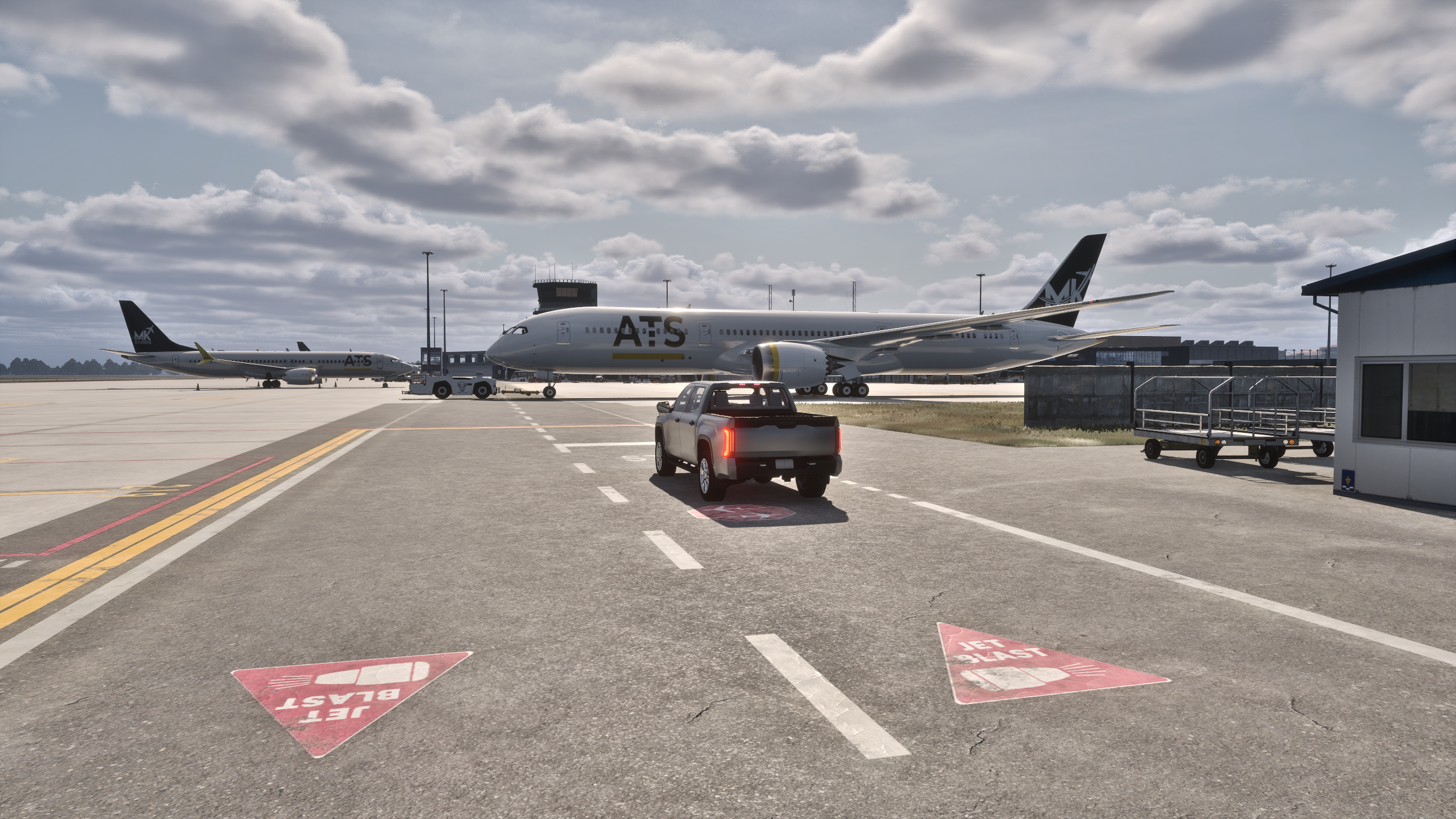
Vehicle-based airside training with an integrated ATC system. Trainees drive the apron, request clearances, and cross taxiways and runways only when the controller allows it.
What the Module Covers
Driving on the airside is a procedural task before it is a driving task. The module trains both: vehicle handling on the movement area, and the clearance discipline that governs where a vehicle is allowed to go.
01
Movement Area Awareness
Airside signage, surface markings and restricted zones, aircraft right-of-way, safety zones and clearance awareness on live stands and service roads.
02
Clearance-Based Access
Taxiways and runways open only on an explicit clearance. Event-driven checkpoints trigger the request, and the controller answers according to the traffic around the vehicle.
03
Scenarios and Free Ride
Nine predefined training scenarios, three per level, plus a Free Ride mode where procedures stay enforced. Additional scenario sets can be added to the module.
04
Conditions and Penalties
Standard, low-visibility and night driving, realistic vehicle behaviour and movement limits, and a penalty system for unsafe manoeuvres and incorrect positioning.
Two drivable vehicles ship with the module: VW Transporter and Toyota Tundra. Further vehicle types are added on scope alignment.
Three Training Levels
Levels are unlocked in order, and each one widens the area the trainee is allowed to enter and raises the controller the vehicle has to talk to.
Two Ways to Talk to the Controller
Communication can be delivered either through predefined phraseology or through speech recognition. Both feed the same Communication Manager, so the exercise, the checkpoints and the scoring stay identical.
Option A
Predefined Scenarios
The trainee selects from a set of correct and incorrect radio calls at each checkpoint. Fast to learn, works on any station, and keeps the exercise focused on procedure rather than pronunciation.
- Phraseology presented as selectable calls
- Incorrect and out-of-sequence calls are included on purpose
- No microphone or audio calibration needed
- Suitable for first contact with ATC procedures
Option B
Voice Recognition
The trainee speaks the call on the radio. Recognition runs locally and offline, with no cloud dependency, currently in English and French.
- Offline, locally running speech recognition
- ATC communication in English and French
- Device recognition and microphone testing before the session
- Closer to the real radio workload and timing pressure
Communication Manager
Event-driven checkpoints
Taxiway and runway checkpoints open the radio exchange at the right moment in the drive.
Exception handling
Invalid, missing and out-of-order commands are handled explicitly instead of stalling the session.
Traffic-dependent responses
The controller answers according to the traffic situation, so a clearance is never guaranteed.
Full logging
Every exchange is recorded with its timing and outcome, and feeds the performance evaluation.
Optional add-on
Follow Me
Follow Me can be delivered on top of the Airside Driving module, or left out entirely. It reuses the same airport, the same vehicles and the same ATC system, and adds the task of leading an aircraft from the moment it is handed over until it is parked or lined up.
Meeting Point and Handover
The vehicle is dispatched to the assigned meeting point and takes the aircraft over from the controller on a defined position.
Leading the Aircraft
Correct distance, speed and lateral position ahead of the aircraft, on the route the controller cleared and not the shortest one.
Route and Clearances
Taxi route read from the clearance, with holding points and crossings requested and confirmed while the aircraft is behind the vehicle.
Release and Return
Aircraft released at the stand or at the assigned holding point, followed by a clean exit from the movement area.
Scope, aircraft types and the number of routes are set during scope alignment. The module runs standalone on the same station if Follow Me training is the only requirement.
Built Around Your Airport, Your Vehicles, Your Procedures
Airside driving is local by definition. The layout the trainee learns, the vehicle they handle and the phraseology they use on the radio are all built on what your station actually operates.
Your Airport
Recreated from the movement area your crews drive:
- Full airport layout: ramp, gates, stands and service roads
- Taxiway lines, markings, guidance signs and stopbars
- Taxiway and apron lighting, road signs and technical roads
- Restricted zones and safety areas as they are marked on site
Your movement area, not a generic aerodrome.
Your Vehicles
Matched to the fleet in use on the airside:
- VW Transporter and Toyota Tundra delivered with the module
- Further vehicle types modelled on request
- Realistic vehicle behaviour and movement limits
- Standard, low-visibility and night driving conditions
If your fleet drives something else, we model yours.
Your Procedures
Aligned with the rules your controllers apply:
- Local phraseology for apron, ground and tower contact
- Your crossing, holding and clearance procedures
- Scenario sets written around your routes and hot spots
- Delivered with documentation and support
Your rules on the radio, not a textbook script.
Assessment and Debrief
A run is only useful if it can be discussed afterwards. Everything the trainee does on the radio and on the surface is scored and available to the instructor.
Trainee View
On the movement area
Drive the assigned task, request and read back clearances, hold where required, and keep the vehicle inside the area the clearance covers.
Instructor Station
Session control and evaluation
Start, restart or end a scenario, follow the radio log live, and review the score afterwards: communication, timing and procedural compliance, with every violation listed.
Runs offline
Speech recognition and the simulation run locally. No cloud service is required inside the airport network.
Station and hardware
Steering wheel and pedals on a dedicated platform, or a compact desk station. Device recognition and testing are built in.
Support and updates
Support packages cover response and resolution times, included remote hours and access to new releases.
No clearance, no movement.
Taxiways and runways stay closed until the controller opens them, and every violation is recorded against the trainee.
Contact usHardware Configuration
Three station configurations, from essential to fully immersive, plus an optional add-on for natural head tracking. Each one runs the same simulation and the same procedures.
More Training Modules
Explore additional simulation modules designed to complement core ground handling training. Each module focuses on specific operational areas, enabling targeted skill development and comprehensive procedural coverage.
Book a Demo
We will drive a full clearance-based exercise with you, in either communication mode, and walk through Follow Me if it belongs in your scope.