

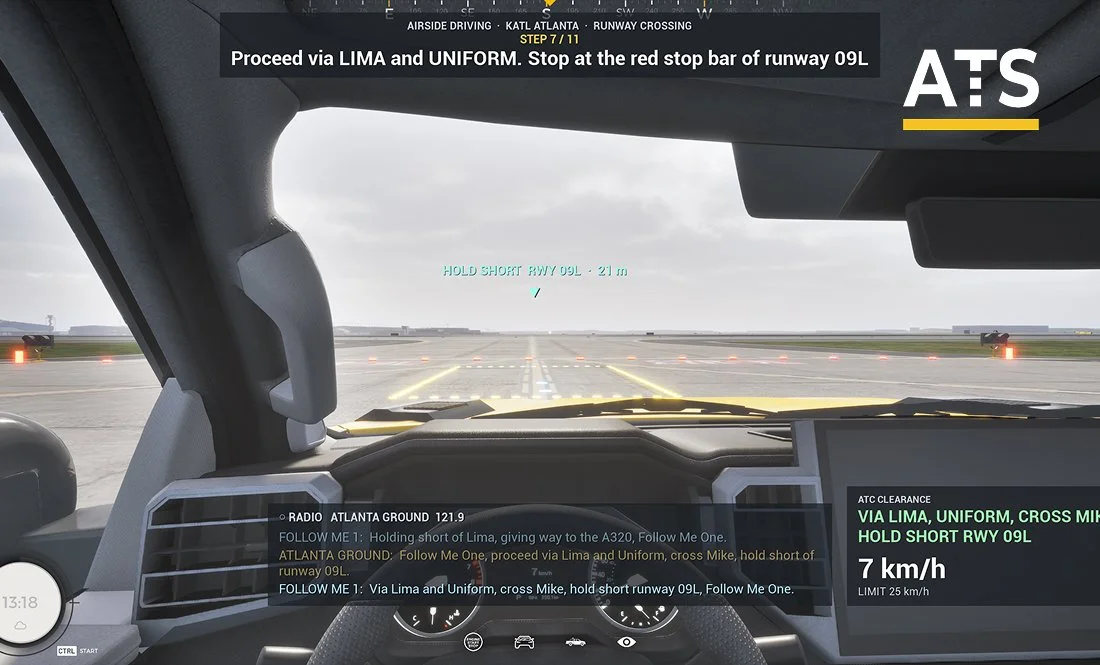
Obtaining the appropriate driving authorisation is an essential part of qualifying to drive at an airport. Maintaining the skills required to operate safely is an ongoing responsibility. Aircraft movements, ground support equipment (GSE), radio communication, changing weather and temporary infrastructure restrictions all influence the decisions drivers make during their daily duties.
Theoretical and practical training are essential, but the situations drivers encounter during a training session depend largely on the conditions and activity at the airport. Not every driver will experience heavy snowfall, reduced visibility, complex aircraft movements or unexpected changes to vehicle routes before obtaining their driving authorisation. Our Airside Driving Simulator, part of Airport Training Simulator (ATS), allows these situations to be incorporated into initial, recurrent and refresher training without disrupting live airport operations.
Different driving permits, different training requirements
The terminology, scope and qualification requirements for airside driving vary across airports and regulatory frameworks. In Europe, ADR.OPS.B.024 of Regulation (EU) No 139/2014 establishes requirements for vehicle driver authorisation and training, distinguishing between drivers operating on aprons and other operational areas and those requiring access to the manoeuvring area. The UK Civil Aviation Authority uses the term Airside Driving Permit (ADP), while Canadian airports such as Toronto Pearson operate an Airside Vehicle Operator's Permit (AVOP) scheme.
In the United States, FAA Advisory Circular 150/5210-20A provides guidance on ground vehicle operations and training in movement and safety areas, while 14 CFR § 139.329 establishes initial and recurrent training requirements for personnel accessing these areas at airports subject to Part 139.
Individual airport operators establish their own permit categories, access restrictions, communication procedures and qualification programmes within the applicable regulatory framework. ATS accommodates these differences through three progressive training levels, which can be configured according to the airport's driving authorisation system and the responsibilities of individual drivers.
Level 1: Apron & Terminal Area
Apron driving requires continuous awareness of aircraft movements, vehicle positioning and ground handling activities. In October 2026, a WestJet aircraft under tow came into contact with a stationary catering truck at Toronto Pearson International Airport, illustrating the risks associated with aircraft and ground vehicles operating in close proximity.
Within ATS, drivers practise navigating service roads, recognising signs and markings, approaching aircraft stands and maintaining safe separation from aircraft and equipment. Exercises introduce interactions with moving aircraft, GSE and other vehicles, requiring trainees to anticipate surrounding activity rather than memorise a fixed route. Airport familiarisation also allows drivers to become acquainted with local infrastructure and movement restrictions before supervised practical training.
Level 2: Taxiway Crossings
Access to taxiways introduces additional procedural and communication requirements. In August 2026, a proximity event involving a Qatar Airways aircraft under tow and a taxiing Jetstar aircraft at Sydney Airport prompted an investigation by the Australian Transport Safety Bureau (ATSB). Its preliminary report describes circumstances involving the identification of aircraft referred to in an ATC instruction.
Training at this level combines vehicle operation with radiotelephony, traffic identification, holding positions and crossing procedures. Drivers must interpret instructions, understand the limits of their clearance and recognise when further clarification is necessary. The exercise requires them to apply procedural knowledge while monitoring aircraft movements and maintaining awareness of their own position.
Level 3: Runway Crossings
Runway access requires appropriate authorisation, strict procedural compliance and accurate positional awareness. A final ATSB report published in November 2026 examined a runway incursion at Melbourne Airport during overnight maintenance works. Shortcomings in the briefing process and difficulties distinguishing the active runway intersection from other crossings were among the contributing factors.
Within ATS, runway crossing exercises focus on runway holding positions, explicit ATC clearances, readbacks and runway incursion prevention. Changes to visibility, traffic and local infrastructure can be incorporated into scenarios, requiring drivers to reassess familiar situations and apply the relevant procedures.
These occurrences illustrate how infrastructure, communication, organisational practices and human performance interact. Rather than attributing incidents solely to driver training, their findings can help airport operators identify situations and procedures that warrant further practice.
ATC communication as part of the driving exercise
For drivers authorised to operate in areas controlled by Air Traffic Control (ATC), knowledge of radiotelephony procedures must translate into effective communication while operating a vehicle. Drivers need to recognise call signs, understand instructions and clearance limits, provide accurate readbacks and maintain radio discipline without losing awareness of surrounding traffic.
In ATS, simulated ATC communication forms part of the driving exercise rather than being treated as a separate theoretical subject. Trainees request clearances, respond to instructions and perform readbacks while navigating the airport. Combining these tasks allows drivers to practise managing their workload, particularly during periods of increased traffic, reduced visibility or more complex taxiway and runway operations. Communication procedures and phraseology can be configured according to local airport procedures and regulatory requirements.
Training for conditions that cannot be scheduled
A driver qualifying during summer may not encounter snowfall, icy surfaces or poor winter visibility until several months later. Similarly, practical training conducted in daylight and good weather offers limited opportunities to experience night operations, heavy precipitation or dense fog. Where Low Visibility Procedures (LVP) are in force, restrictions on vehicle movements, access to certain areas and communication requirements may also change.
Weather in ATS is not simply a visual feature. Rain, snow and ice affect surface traction, braking distances and vehicle handling, while fog and precipitation reduce visibility. Terrain gradients also influence vehicle dynamics. Repeating the same exercise under different conditions allows drivers to experience how reduced visibility, changes in surface friction and longer stopping distances affect an otherwise familiar operation. Airports can prepare personnel for seasonal conditions before they occur and give experienced drivers an opportunity to practise procedures they use infrequently.
Consistent training without predictable scenarios
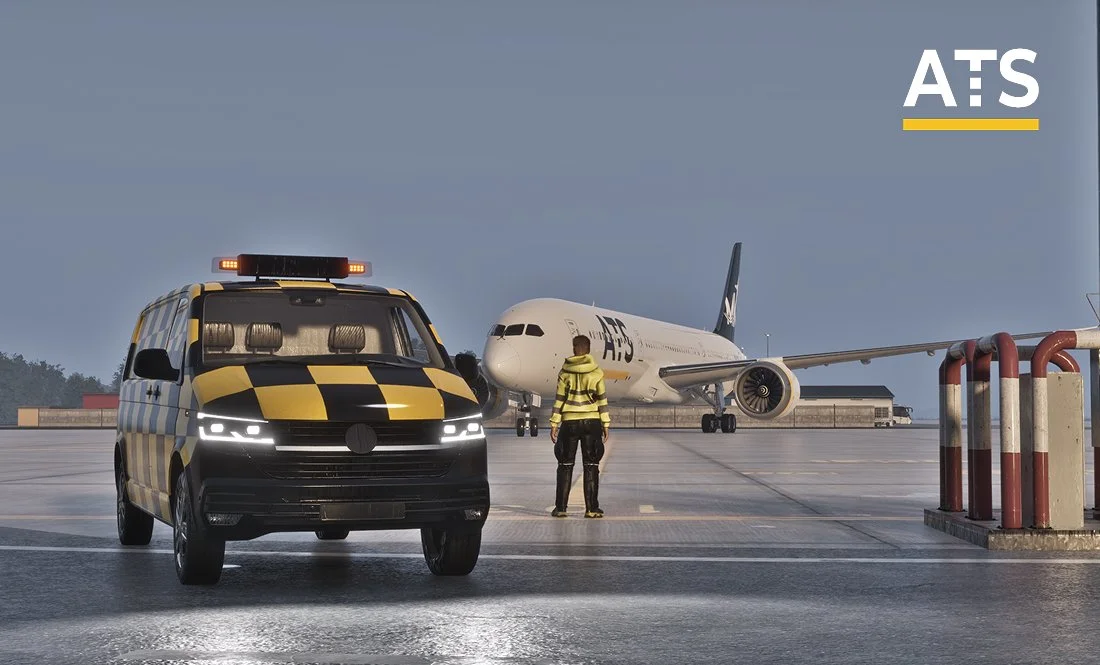
Two drivers completing the same practical training programme may encounter very different traffic, weather and ground handling activity. ATS allows instructors to reproduce comparable training conditions across multiple sessions while introducing variations that require trainees to apply their knowledge rather than memorise a sequence of actions.
Our Airside Driving Simulator combines structured scenarios with Free Ride Mode. Individual scenarios address specific learning objectives, while Free Ride Mode allows drivers to navigate the airport independently, applying the relevant procedures and access restrictions. Instructors can review unsafe manoeuvres, procedural deviations and decisions made during an exercise, discuss errors with trainees and repeat the scenario to assess improvement. Drivers have the opportunity to learn from mistakes without exposing aircraft, personnel or airport infrastructure to risk.
Every airport has its own procedures
Even airports operating under the same regulatory framework can have different driving authorisations, vehicle routes, speed limits, radio procedures and training priorities. An airport operating in severe winter conditions may require a different range of exercises from one with congested aprons, complex taxiway intersections or high traffic density.
Working with airport operations, safety and training teams, we reproduce the airport's infrastructure and configure training scenarios according to its driving authorisation system, local procedures and communication requirements. Previous incidents, internal safety reports and identified hazards can also form the basis of dedicated exercises for both new and experienced drivers.
Developed by MK Studios, Airport Training Simulator complements existing airport qualification and recurrent training programmes. By combining realistic airport environments, vehicle physics, ATC communication and instructor-led exercises, our Airside Driving Simulator gives airports greater control over what their drivers experience during training, regardless of the season or the activity taking place on the airside.
Contact our team to discuss how Airside Driving Simulator can be incorporated into your airport's training programme.
